
Steam Saving in Sizing: A Smart Step Towards Sustainable Manufacturing
Steam Saving in Sizing: A Smart Step Towards Sustainable Manufacturing
In today’s weaving business, profitability is shaped by far more than loom speed alone. Utility costs, carbon pressure, process stability, and buyer expectations all influence a mill's competitiveness. Among the many steps in warp preparation, sizing stands out because it protects the warp yarn from weaving stress and strain — but it also consumes significant thermal energy during drying. This means that every kilogram of steam has a direct impact on operating costs and sustainability performance.
For customers and entrepreneurs, the real question is not only how to size well, but how to do it with lower operating costs, greater sustainability, and better control over production economics. This is why steam saving in sizing has become a strategic topic. When steam is reused intelligently instead of being wasted, mills can reduce fresh steam demand, improve energy efficiency, and create a stronger value proposition for both internal stakeholders and external buyers.
Many weaving businesses are already familiar with the hidden pain of conventional sizing: large amounts of energy enter the machine as steam, but a meaningful share of that value leaves the process underutilised. In traditional drying systems, hot condensate and flash steam are often not fully recovered within the machine. The result is simple—more live steam is needed from the boiler; costs go up, and the carbon footprint increases.
What makes this more critical is that drying is not just a utility function. It directly affects yarn quality, production stability, and weaving performance. If drying is poorly controlled or too energy-intensive, the mill can experience higher cost per meter, lower operational efficiency, and more pressure from customers asking for greener manufacturing.
Challenges with conventional sizing machine
Saving steam in sizing is not as easy as simply reducing heat input. The process must still deliver the right drying profile, the right yarn condition, and the right productivity. That creates several practical challenges:
- The yarn must receive effective size protection without creating an unnecessary drying load.
- The drying section must remove moisture consistently without harming yarn properties such as flexibility and strength.
- Energy-saving measures must work under real production conditions, where recipes, speeds, and machine utilisation vary.
- Any improvement in energy efficiency must not create extra downtime, maintenance risk, or process complexity.
- Fleece yarn (backing): A thicker, bulky yarn that floats on the technical back of the fabric and is later brushed (napped) to create the soft fleece interior
- Binding yarn (tie-in): A finer yarn (often polyester) that binds the face and fleece yarns together
How Modern Sizing Technology Improves Energy Efficiency
Modern sizing technology is moving beyond simple heat supply toward smarter energy reuse. One of the most interesting recent developments is the CASCADE concept used with cylinder-dryer systems. The principle is straightforward but powerful: instead of allowing valuable process of energy to leave the machine unused, part of the steam and condensate energy is recovered and reused inside the drying line.
In practice, the first dryer section operates at a higher pressure where steam transfers heat to dry the warp and then condenses. Rather than sending that hot condensate away immediately, it can be directed into a flash tank. When the pressure drops, a usable vapour phase—often called flash steam—is generated again. This recycled steam can then be used in later dryer sections, where the heat demand is lower. By matching the pressure levels across the cylinder zones, the machine uses the energy more intelligently instead of wasting it.
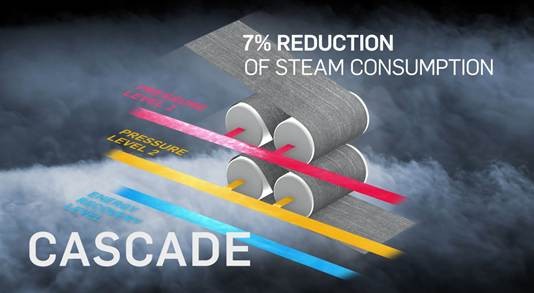
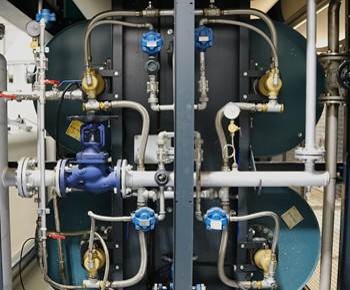
(Courtesy: KARL MAYER PROSIZE –patented CASCADE – Steam saving system)
An additional advantage of this approach is transparency. With sensor-based monitoring, mills can see how much steam is being recycled and can translate that into operational savings and emission reduction. For business owners, measurable efficiency is much more valuable than a generic energy-saving claim.
Where does this matter most?
Steam-saving technology is especially relevant in mills that run multi-cylinder sizing machines, high production hours, and run continuous weaving programs. The bigger the output and the longer the operating hours, the greater the financial value of every percentage point of steam reduction.
It is also highly relevant for companies serving demanding export markets, the terry towel segment, denim, technical textiles, premium shirting, workwear, and other segments where sustainability reporting is becoming part of business qualifications. In these markets, utility efficiency is no longer only an internal KPI—it can also support customer trust and audit readiness.
Benefits
- Lower live-steam demand from the boiler house.
- Reduced exposure to rising steam and fuel costs.
- More efficient utilisation of energy already available within the drying process.
- Improved visibility of utility performance through measurement and monitoring.
- Support for more stable production economics over long operating periods.
- Contribution to lower CO2 emissions and stronger sustainability positioning.
What makes this technology different
The real differentiator is not just “energy saving” as a general promise. The stronger value lies in inline energy recycling—recovering and reusing thermal energy inside the machine, where it directly supports the process. This makes the improvement practical, process-integrated, and measurable.
Another differentiator is that modern systems can demonstrate verifiable results. Practical reports from industry show that steam savings can be quantified in real production, which helps decision-makers justify investment more confidently.
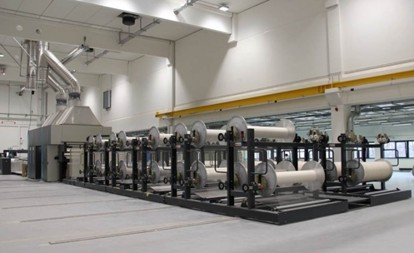
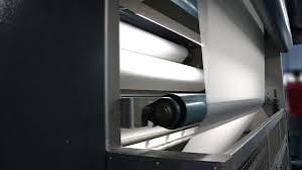
(Courtesy: KARL MAYER PROSIZE)
What helps at a glance
- Lower production cost per running meter.
- Reduced fresh-steam consumption without compromising production intent.
- A smaller carbon footprint with measurable improvement.
- Better readiness for sustainability discussions, audits, and buyer expectations.
- More confidence in long-term cost control.
- A stronger business case for modernisation in warp preparation.
Conclusion
Saving steam in the sizing process is important because it directly connects utility cost, process performance, and sustainability. For mills operating in a highly competitive market, every avoidable steam loss is a missed opportunity to improve profitability and strengthen environmental performance. As energy prices remain under pressure and customer expectations continue to rise, steam recovery and intelligent drying control are becoming central to modern warp preparation.
In this context, KARL MAYER PROSIZE technology offers a clear customer advantage. With its modern sizing platform and patented CASCADE steam-condensate recycling concept, it helps customers reduce fresh-steam consumption, improve visibility of savings, support lower CO2 emissions, and strengthen business competitiveness through smarter, more efficient sizing.
Newsletter sited - under typical operating conditions – 5,000 hours per year with an efficiency rate of 83% – Getzner Textil saves approximately €8,500 annually, while cutting CO2 emissions by 59 tons per year.
Written by –
Mr Guruprasad Shetty